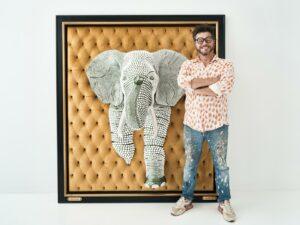
Eddy Maniez l’artiste et sculpteur animalier Il expose son poulpe géant dans le hall de l’hôtel Negresco à Nice
Eddy Maniez l’artiste et sculpteur animalier
Français
Eddy MANIEZ naît le 6 janvier 1969 à Grasse, dans les Alpes-Maritimes.
Fils d’un père mécanicien – parfois tatoueur – et d’une mère employée
en parfumerie, il grandit aux côtés d’un frère aîné de quatre ans. Chez
lui, il n’y a ni bibliothèque ni télévision ; sa chambre devient alors son
refuge, un espace de liberté et d’imagination.
Très tôt, le dessin s’impose. À 14 ans, il crée déjà de petites compositions
sur plaques de plexiglas superposées, jouant sur la profondeur. Deux ans
plus tard, il dessine pour son père des motifs de tatouages, avant de se
lancer dans la construction de maisons miniatures et villages entiers…
réalisés exclusivement en allumettes. Un travail minutieux et patient, en
contraste avec son enfance passée dans les HLM.
À 19 ans, il découvre la sculpture à la lame de rasoir sur les fruits
des marronniers : des villages miniatures, peints, décorés et parfois
illuminés, qu’il vend avec succès sur les marchés provençaux. À 21 ans, il
explore l’aquarelle, l’acrylique, l’huile, peignant avec frénésie paysages,
portraits, maisons et scènes de nature. Alors forestier, il puise son
inspiration dans les animaux et les forêts.
À 25 ans, il s’attaque aux bas et hauts reliefs sur de vieux supports
en bois – portes de granges, volets anciens – en expérimentant une
technique instinctive : à la manière de Jackson Pollock, il verse du plâtre
liquide à séchage rapide, puis a quelques minutes pour y intégrer des
objets glanés dans son atelier : clous, fossiles, pommes de pin, nids,
vieux livres… Son atelier, une cave voûtée en pierre avec un sol en terre
battue, devient un véritable laboratoire de création. Ses œuvres, mises
en scène sans plan préalable, dégagent une force silencieuse, des «
écrins de nature ».
Il transmet son savoir-faire pendant deux ans à l’atelier des Beaux-Arts
de Grasse, incitant ses élèves à oser se lancer. Il intervient également
dans les écoles du Haut-Pays Grassois pour initier les enfants au
bricolage et à la création.
En 1997, sur le port de Cannes, une idée pratique change le cours de
sa carrière : comment protéger la vaisselle et les objets fragiles à bord
des bateaux ? Il imagine alors de recouvrir des bouteilles de verre de
picots en silicone. Test concluant : les bouteilles résistent aux chocs !
Présentées dans une boutique de décoration de luxe, elles connaissent
un succès immédiat. Rapidement, il applique cette technique à des
cendriers à cigares, en y ajoutant une touche précieuse : des cristaux
Swarovski. Le pari est audacieux : sublimer un matériau brut en objet
d’art. Depuis, Eddy MANIEZ a décliné sa technique unique au monde
sur une multitude de supports : animaux, vêtements, plafonds, objets
utilitaires et pièces monumentales. Installé dans son atelier varois, il
s’inspire du monde animal, qu’il affectionne particulièrement, et expose
aujourd’hui dans les plus grandes galeries internationales. Installé dans
le sud de la France, à une heure de Saint Tropez dans le département du
Var à Tourrettes , il travaille avec ses collaborateurs dans une ambiance
chaleureuse et artistique.
Artiste engagé, conscient des enjeux environnementaux, il calcule
désormais le bilan carbone de chacune de ses créations et s’engage
à planter des arbres – notamment à Madagascar – via l’association
Pachamama Madagascar, qui sensibilise les enfants défavorisés à la
protection de leur environnement.
English
Eddy MANIEZ was born on January 6, 1969, in Grasse, in the Alpes-
Maritimes region of France. The son of a mechanic – occasionally a
tattoo artist – and a mother working in a perfume shop, he grew up
alongside an older brother, four years his senior. At home, there were
no books and no television; his bedroom quickly became his sanctuary,
a space for freedom and imagination.
From a very young age, drawing became his passion. At 14, he was
already creating small compositions on layers of plexiglass, playing
with the illusion of depth. By 16, he was designing tattoo patterns for
his father, before turning to the meticulous construction of miniature
houses and entire villages made entirely of matchsticks – a patient,
painstaking craft, in stark contrast to his childhood in the housing
projects.
At 19, he discovered razor-blade carving on horse chestnuts: tiny
villages, painted, decorated, and sometimes even illuminated, which
he successfully sold at Provençal markets. At 21, he began exploring
watercolors, acrylics, and oils, painting landscapes, portraits, houses,
and natural scenes with great intensity. Working at the time as a
forester, he drew inspiration from the wildlife and forests around him.
At 25, he turned to bas- and high-relief work on old wooden surfaces
– barn doors, antique shutters – experimenting with an instinctive
technique: in the style of Jackson Pollock, he poured fast-drying
liquid plaster onto the wood, then had only minutes to embed objects
collected in his studio: nails, fossils, pinecones, bird nests, old books…
His studio, a vaulted stone cellar with a dirt floor in the mountains,
became a true creative laboratory. These works, composed without
any preliminary sketches, radiated a silent vitality – true “jewels of
nature.” He went on to share his know-how for two years at the Grasse
School of Fine Arts, encouraging his students to dare what they
had not yet dared: to take the leap. He also led creative workshops
in local schools in the upper Grasse region, introducing children to
plasterwork, painting, and hands-on artistic creation.
In 1997, on the port of Cannes, a practical question sparked a turning
point in his career: how to protect fragile dishes and decorative
objects on boats from damage caused by rough seas? His inventive
solution was to cover glass bottles with silicone studs. The test
worked perfectly: the bottles resisted impacts! He presented five of
them to a luxury home décor boutique in Cannes, where they were
an instant hit. Soon after, he applied the technique to cigar ashtrays,
adding an extra touch of refinement with Swarovski crystals. The bold
idea of transforming an ordinary construction material into a work
of art had succeeded. Located in the south of France, an hour from
Saint-Tropez, in the village of Tourrettes in the Var region, he works
with his team in a warm and artistic atmosphere.
Since then, Eddy MANIEZ has applied his unique, world-exclusive
technique to a wide variety of creations: animals, clothing, ceilings,
utilitarian objects, and monumental works. From his workshop
in the Var region, he draws inspiration from the animal world, so
dear to his heart, and now exhibits in major international galleries.
An environmentally conscious artist, he now calculates the carbon
footprint of each of his works and has committed to planting trees
– particularly in Madagascar – through the Pachamama Madagascar
association, which works to help disadvantaged children and teach
them to protect their environment for the long term.